The Engineer’s Guide to MIL-DTL-5541: A Deep Dive into Chemical Conversion Coatings
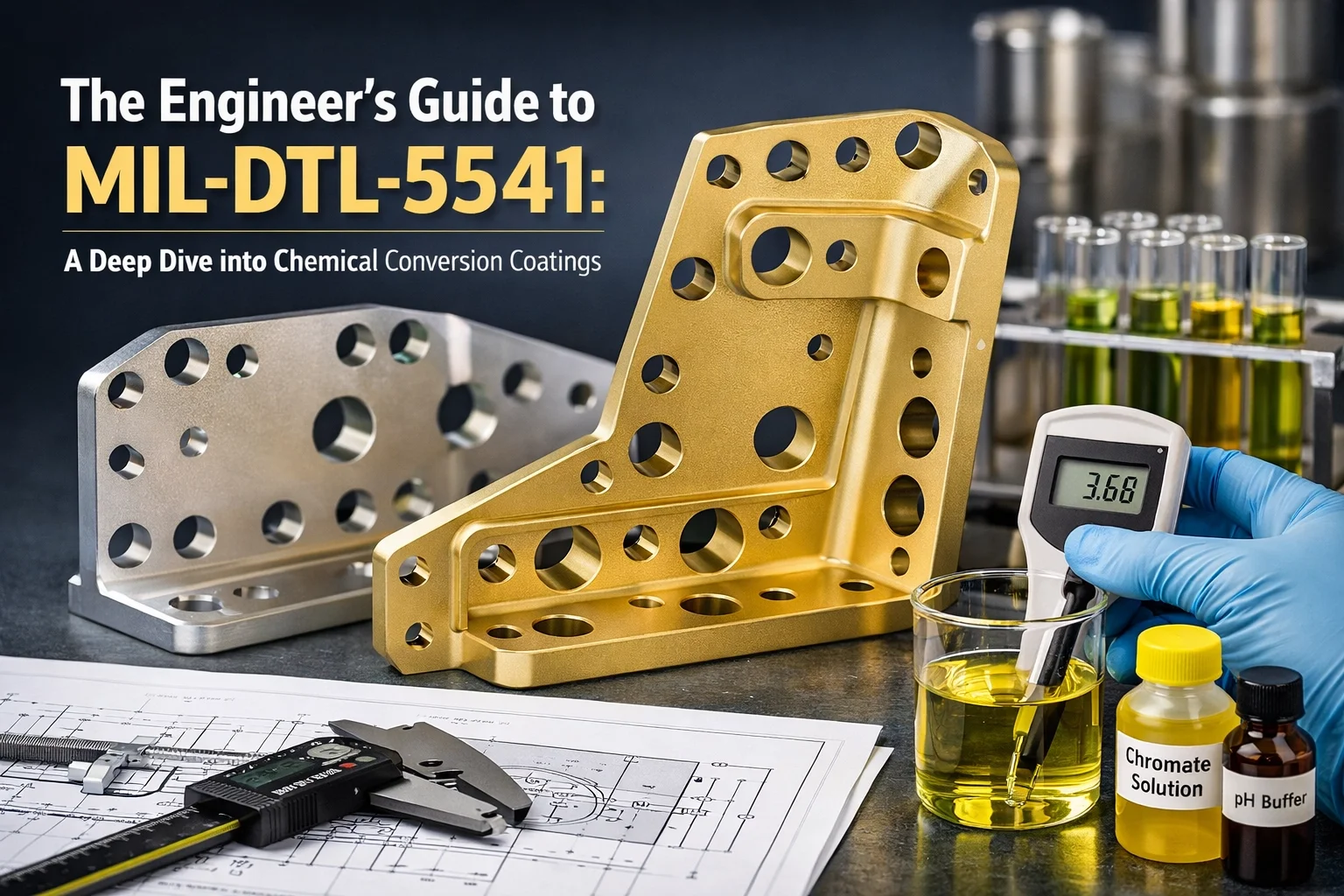
MIL-DTL-5541 is the prevailing military specification governing chemical conversion coatings for aluminum and aluminum alloys. This process, frequently referred to by trade names such as Alodine or Iridite, produces a protective surface film through a chemical reaction between the aluminum substrate and the coating solution. Unlike anodizing, which is an electrolytic process that builds a thick aluminum oxide layer, chemical conversion coating is a non-electrolytic dip or spray process that results in a much thinner film. This film provides a unique combination of corrosion resistance, paint adhesion, and, crucially, electrical conductivity.
For engineers and quality managers in the aerospace, defense, and electronics sectors, understanding the nuances of MIL-DTL-5541 is essential for ensuring component longevity and performance. Alberta Base Anodizing provides precision chemical conversion coating services that strictly adhere to these rigorous standards, ensuring every part meets the necessary salt spray and electrical resistance requirements.
The Evolution of the Specification: MIL-C-5541 to MIL-DTL-5541
The current military standard, MIL-DTL-5541, superseded the older MIL-C-5541 designation. While many legacy drawings still reference MIL-C-5541, the industry has standardized on the "Detail" (DTL) specification to reflect modern performance requirements and environmental regulations. The specification is approved for use by all departments of the U.S. Department of Defense and is widely used
The primary function of the coating is to inhibit corrosion and serve as a base for organic coatings (paints and primers). Because the film is significantly thinner than an anodic layer, it does not significantly change the dimensions of the part, making it ideal for precision-machined components with tight tolerances.
Defining the Coating Types: Chromium Composition
MIL-DTL-5541 categorizes coatings into two types based on their chemical composition and environmental impact. The choice between Type I and Type II is often dictated by regulatory requirements such as RoHS (Restriction of Hazardous Substances).
Type I: Hexavalent Chromium
Type I coatings utilize hexavalent chromium (Cr6+) as the active agent. These coatings have been the industry standard for decades and are known for their distinct appearance:
Appearance: Typically iridescent gold, tan, or brown. It can be specified as clear, though clear Type I is less common.
Performance: Known for exceptional self-healing properties if the surface is lightly scratched.
Compliance: Type I is not RoHS compliant due to the presence of hexavalent chromium, which is restricted in many global markets and industries.
Alberta Base Anodizing does NOT currently offer Hex Chrome conversion coating.
Type II: Non-Hexavalent Chromium
Type II coatings are formulated without hexavalent chromium, usually employing trivalent chromium (Cr3+) or other non-chrome chemistries.
Appearance: Typically clear or colorless.
Compliance: Type II is fully RoHS compliant, making it the preferred choice for modern electronics, telecommunications, and consumer goods.
Performance: Modern Type II formulations provide corrosion protection and electrical conductivity comparable to Type I.
Categorization by Class: Functional Application
In addition to Type, the specification defines two primary Classes based on the desired performance characteristics of the finish.
Class 1A: Maximum Corrosion Protection
Class 1A is designated for maximum protection against corrosion, whether the part is painted or unpainted.
Thickness: Heavier and thicker than Class 3 films.
Primary Use: Structural components, tanks, tubing, and external aircraft parts.
Adhesion: Provides an excellent mechanical bond for subsequent paint or powder coating systems.
Resistance: Offers higher electrical resistance than Class 3.
Class 3: Electrical Conductivity
Class 3 is specified when low contact resistance is required for electrical and electronic applications.
Thickness: A much thinner film compared to Class 1A.
Primary Use: EMI/RFI shielding, grounding points, and electronic chassis where the substrate must remain conductive.
Corrosion Protection: Because the coating is thinner, it offers lower corrosion resistance than Class 1A. However, it must still pass 168 hours of salt spray testing.
Technical Performance and Testing Requirements
To remain compliant with MIL-DTL-5541, finishing facilities like Alberta Base Anodizing must perform regular process control and performance verification testing.
Corrosion Resistance (Salt Spray)
Both Class 1A and Class 3 coatings must be capable of withstanding 168 hours of salt spray exposure per ASTM B117. After testing, the specimens must show no more than five isolated spots of corrosion per test panel, and no spot can be larger than 0.031 inches in diameter. Areas within 0.25 inches of the edges or identification markings are typically excluded from evaluation.
Electrical Contact Resistance
For Class 3 coatings, the electrical resistance is a critical metric. The specification defines the following limits:
As Supplied: The contact resistance must not exceed 5,000 microohms per square inch when measured under a nominal electrode pressure of 200 psi.
Post-Salt Spray: After the 168-hour salt spray test, the resistance must not exceed 10,000 microohms per square inch.
Adhesion Testing
If the conversion coating is intended as a base for paint, it must demonstrate superior adhesion to the base metal. This is verified using ASTM D3359 (Tape Test), where the coating must achieve a rating of 4A or better.
Critical Industry Applications
Aerospace and Defense
In aerospace, MIL-DTL-5541 is used extensively for internal structural components that require corrosion protection but do not warrant the weight or dimensional change of Type II anodizing. It is also used as a repair coating for damaged anodized surfaces and as a post-treatment for ion-vapor deposition (IVD) aluminum.
Electronics and Telecommunications
For electronics, the Class 3 coating is the industry standard. It allows for effective grounding and EMI shielding while preventing the aluminum from oxidizing and creating an insulating barrier. Most server racks, enclosures, and heat sinks utilize Type II, Class 3 finishes to meet RoHS requirements while maintaining electrical integrity.
Industrial Manufacturing
In general industrial applications, conversion coatings are used to provide a reliable surface for powder coating. The chemical bond created by the conversion film ensures that the powder coat does not delaminate or "creep" due to sub-surface corrosion if the paint is scratched.
Specifying MIL-DTL-5541 on Engineering Drawings
Precision in specification is vital to avoid production delays and quality escapes. A proper callout on an engineering drawing should include the specification number, the Type, and the Class.
Example Callout:
> Finish: Chemical Conversion Coating per MIL-DTL-5541, Type II, Class 3.
If specific areas of the part require masking to ensure the coating only contacts certain surfaces (though rare for conversion coatings compared to anodizing), these should be clearly identified. For complex parts requiring both anodizing and conversion coating, engineers should reference the precision masking and plugging capabilities of their finishing partner to ensure zero cross-contamination.
Beyond MIL-SPEC: ASTM, ISO, and AMS Standards
While MIL-DTL-5541 is the most common North American callout for chemical conversion coating on aluminum, drawings frequently reference other specifications based on industry, customer flow-downs, or regional standards. These documents generally target the same functional outcomes—corrosion protection, paint adhesion, and electrical conductivity—but use different qualification language, test methods, and acceptance criteria.
Key standards engineers commonly encounter include:
ASTM B449 — Primary commercial standard for chromate conversion coatings on aluminum.
ASTM B921 — Standard focused on non-hexavalent (Trivalent/TCP) conversion coatings; commonly used to support REACH and RoHS compliance requirements.
AMS2473 & AMS2474 — SAE Aerospace conversion coating standards:
AMS2473 — General-purpose aerospace conversion coating requirements.
AMS2474 — Used when low electrical resistance is required (functionally similar to a Class 3 intent).
AMS2477 — Specifically targeted to low electrical resistance conversion coatings on aluminum alloys.
ISO 10546 — International chromate conversion coating standard; commonly seen on drawings originating from European or globally distributed engineering teams.
Regardless of the document title, the functional target remains consistent: corrosion resistance, paint/primer adhesion, and conductivity where required. Alberta Base Anodizing supports engineering and quality teams in interpreting these standards and applying the correct process controls to match the drawing intent and performance requirements.
For more information on our capabilities or to request a quote for your next project, please visit our contact page or explore our gallery to see our work in action.
The Alberta Base Anodizing Advantage
Achieving consistent results with chemical conversion coatings requires strict adherence to process controls. At Alberta Base Anodizing, we manage every variable, from solution concentration and pH to temperature and immersion time, to ensure that every batch meets the MIL-DTL-5541 standard.
Our facility is equipped to handle both small-batch precision components and large-scale industrial runs. We view ourselves as an extension of your engineering team, providing technical guidance on finish selection to ensure your project's success. Whether you require the high-performance corrosion resistance of Class 1A or the specialized conductivity of Class 3, our metal finishing expertise ensures your parts are protected and compliant.
For more information on our capabilities or to request a quote for your next project, please visit our contact page or explore our gallery to see our work in action.